Script Stickers, Names of Week Scripts
In the realm of digital planning and creative asset management, the difference between a functional system and a cluttered mess often comes down to visual consistency. Script Stickers, Names of Week Scripts offers a specialized solution for professionals who require high-quality, thematic elements to organize their schedules, branding materials, or educational resources. This collection is not merely a set of decorative images; it is a workflow tool designed to streamline how creators label, track, and present time-based data.
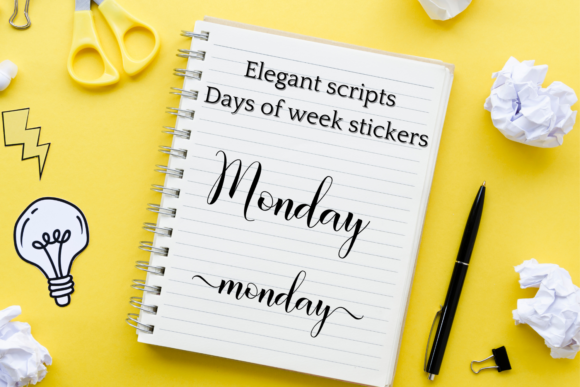
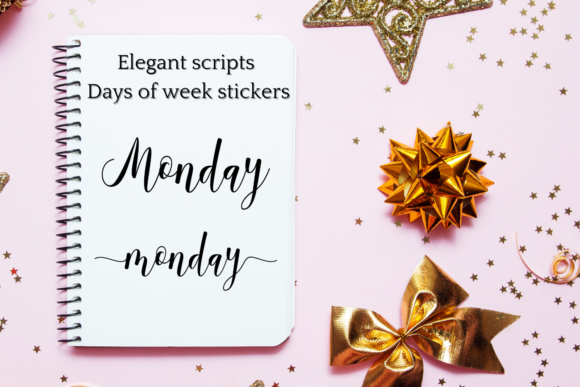
The core value of this asset lies in its specific design language: ♥ CLASSICAL BLACK FONT- DAYS OF WEEK. By utilizing a classical script style rendered in stark black against transparent backgrounds, these stickers provide a level of elegance and readability that standard sans-serif fonts often lack. Whether you are a project manager organizing a Gantt chart, an educator preparing lesson plans, or a small business owner designing social media content, having distinct, high-resolution identifiers for each day of the week allows for immediate visual recognition.
Understanding the Asset Specifications
Before integrating these assets into your production pipeline, it is essential to understand exactly what you are working with. The package contains Quantity 14 clip arts, representing the seven days of the week in two distinct versions. This duality is crucial for maintaining variety without sacrificing brand identity. For instance, one version might feature a more flowing, cursive script, while the other could be slightly bolder or have different ligature connections, giving you flexibility in layout composition.
Each individual file is provided as a PNG format image with a Size 10 x 2 aspect ratio and a resolution of 300 dpi. The 300 DPI specification is non-negotiable for print workflows. If you intend to use these stickers on physical planners, business cards, or marketing flyers, the high resolution ensures that the intricate details of the classical font remain crisp and do not pixelate when scaled. The transparent background is equally important; it eliminates the need for manual masking or background removal, allowing you to drop the sticker directly onto any color, texture, or gradient within your design software.
Integration into Professional Workflows
How does Script Stickers, Names of Week Scripts fit into the daily operations of a busy professional? The answer lies in the preparation phase of any project. When launching a new campaign or structuring a semester curriculum, the first step is often establishing a timeline. Instead of manually typing out "Monday," "Tuesday," etc., which can look generic and disrupt the visual flow of a document, inserting these script stickers creates an immediate hierarchy.
Consider a marketing team preparing a weekly content calendar. They can place the Monday script sticker at the top of a blog post schedule, the Wednesday sticker above a video shoot list, and so on. Because the files are individual PNGs, they can be easily dragged and dropped into tools like Adobe Photoshop, Canva, Microsoft PowerPoint, or even email templates. The process-oriented approach here saves significant time during the execution phase. You spend less time formatting text boxes and more time focusing on the actual content strategy.
For educators and freelancers, these stickers serve as organizational anchors. A freelancer managing multiple client projects might create a master dashboard where each client's tasks are color-coded by day. Using the classical black font provides a neutral yet sophisticated contrast that works well alongside various accent colors. It acts as a visual separator, making complex spreadsheets or digital calendars easier to scan quickly. This efficiency reduces cognitive load, allowing you to make faster decisions about task prioritization.
Creative Applications and Design Consistency
Moving beyond pure utility, the aesthetic quality of Script Stickers, Names of Week Scripts makes them invaluable for branding and creative direction. The "Classical Black Font" style evokes a sense of tradition and reliability. In an era where digital designs often lean heavily towards minimalism or neon aesthetics, there is a growing market for vintage-inspired, classic typography that feels grounded and trustworthy.
When creating branded materials such as newsletters, event invitations, or product packaging, consistency is key. These stickers ensure that every reference to a day of the week maintains the same typographic voice. If you were to mix different fonts for days of the week, the result would appear disjointed. By using the two available versions of the script, you can introduce subtle variation to prevent monotony while keeping the overall theme cohesive. For example, you might use Version A for headers and Version B for sub-tasks, creating a visual rhythm that guides the reader's eye through the document.
The transparency of the PNG files also allows for layering techniques that are common in advanced graphic design. You can place a script sticker over a textured paper background, a photograph, or a gradient mesh to create depth. This capability transforms simple labels into integrated design elements. A photographer might overlay the Tuesday sticker on a portfolio page to indicate a shooting schedule, blending the text seamlessly with the imagery rather than having it sit awkwardly on top.
Technical Considerations and Quality Control
While the creative possibilities are vast, successful implementation requires attention to technical details. Since each clip art is an individual PNG format image, file management becomes a critical part of the workflow. Professionals should establish a dedicated folder structure immediately upon download. Organizing the files by version (e.g., "Week_Scripts_V1" and "Week_Scripts_V2") prevents confusion during the design process. This organizational habit pays off when revisiting old projects or collaborating with team members who need to locate specific assets quickly.
Compatibility is another factor to consider. While PNG is a universally supported format, the 300 DPI resolution means the file sizes may be larger than typical web graphics. When uploading these assets to a website or a cloud storage platform, ensure the compression settings do not degrade the quality. If the destination is strictly for web display (72 DPI), you can resize the images down after downloading to improve loading speeds without losing the integrity of the original source file. However, always keep the original 300 DPI master copies for future print needs.
Usability extends to the sizing capabilities. With a base size of 10 x 2 units (likely inches or centimeters depending on your software's settings), these stickers are versatile enough to be scaled up for large banners or scaled down for small mobile notifications. The script font is designed to hold its shape under transformation, meaning you won't encounter issues with broken letters or distorted curves when resizing. This reliability is essential for maintaining a professional standard across all deliverables.
Long-Term Utility and Scalability
The true test of any digital asset is its longevity. Script Stickers, Names of Week Scripts is built for long-term use. Unlike trendy fonts that may fall out of fashion in a year or two, classical script styles possess a timeless quality. This makes them an excellent investment for building a library of evergreen resources. Whether you are planning a project today or five years from now, these stickers will remain relevant.
Furthermore, the two-version quantity allows for scalability. As your projects grow in complexity, you will need more visual cues to differentiate between similar tasks. Having two distinct styles of the same font family provides the necessary room for expansion without introducing a third, potentially clashing, typeface. This strategic choice supports a modular approach to design, where components can be mixed and matched based on the specific requirements of the current task.
In conclusion, integrating Script Stickers, Names of Week Scripts into your workflow is a practical decision that enhances both the aesthetic and functional aspects of your work. From the initial planning stages to the final presentation of a project, these assets provide a reliable, high-quality method for labeling time. By leveraging the 300 DPI resolution, transparent backgrounds, and dual-version options, professionals can achieve a level of polish and organization that distinguishes their output from the competition. Whether you are a marketer crafting a campaign, an educator designing a syllabus, or a creator building a personal brand, these clips offer the precision and style needed to execute your vision effectively.