Thundering: A Comprehensive Evaluation of a Handwritten Display Typeface
Selecting the right typography is rarely a matter of simply picking the first option that appears on a list. For designers, content creators, and brand strategists working with audiences aged 20 to 50, the choice of typeface carries significant weight in how a message is perceived. It influences tone, credibility, and emotional connection. Among the vast array of available fonts, Thundering has emerged as a distinctive option for projects requiring a specific blend of sweetness and friendliness. This article provides an objective analysis of what Thundering is, its technical characteristics, and how it fits into broader design contexts compared to other handwritten styles.
Defining the Character of Thundering
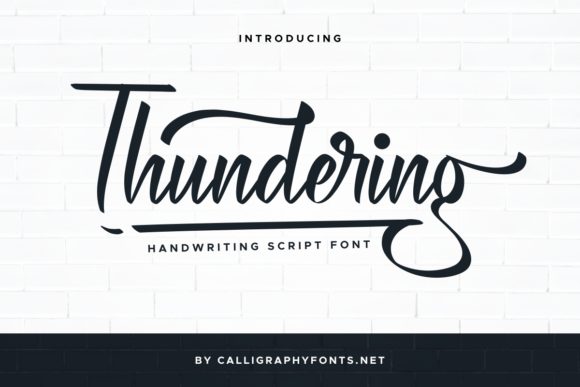
At its core, Thundering is a sweet and friendly handwritten font. Unlike rigid geometric sans-serifs or formal serif typefaces that dominate corporate branding, Thundering offers a natural and unique style that mimics the imperfections of human penmanship. This organic quality makes it incredibly fitting for a large pool of designs where warmth and approachability are desired. The font avoids the stiff, uniform look of digital handwriting simulations, instead offering strokes that feel fluid and genuine.
The distinctiveness of Thundering lies in its ability to balance legibility with artistic flair. While many display fonts sacrifice readability for style, Thundering maintains a clear structure that allows text to be read comfortably even at smaller sizes. This makes it versatile enough for headlines, subheadings, and short body copy in editorial layouts. The "sweet" nature of the letterforms suggests a positive, inviting atmosphere, which is particularly effective for lifestyle brands, educational materials, and creative portfolios.
Technical Accessibility and Glyph Management
One of the most critical factors for professional designers when evaluating a new font is the accessibility of its character set. Thundering utilizes PUA (Private Use Area) encoding. In practical terms, this means the font relies on a specific mapping system to access all of its glyphs and swashes with ease. While some users may initially find PUA encoding less intuitive than standard Unicode, it offers a significant advantage in flexibility.
- Comprehensive Swash Library: Designers can access a wide variety of alternate characters, ligatures, and decorative swashes without needing to install multiple separate files.
- Customization Control: Because the glyphs are mapped within the Private Use Area, the font allows for granular control over individual letter variations, enabling highly customized typographic treatments.
- Workflow Efficiency: Once the keyboard layout or input method is configured, accessing these special characters becomes seamless, streamlining the design process.
This technical feature ensures that Thundering is not just a static image but a dynamic tool. It allows creators to inject personality into every word, ensuring that the final output feels bespoke rather than templated.
Comparative Analysis: Thundering vs. Standard Handwritten Styles
To understand where Thundering fits in the market, it is necessary to compare it with the broader category of handwritten fonts. The landscape of script and hand-drawn typefaces is saturated, ranging from casual cursive to brush scripts and marker-style prints. How does Thundering differentiate itself?
Many handwritten fonts fall into two extremes: they are either too chaotic to read or too rigid to feel authentic. Chaotic scripts often lack consistent baselines, making them difficult to use in multi-line text blocks. Conversely, rigid scripts often look like they were traced by a machine, lacking the subtle pressure variations that make handwriting feel real. Thundering occupies a middle ground. Its natural style avoids the excessive flourishes found in calligraphic scripts while retaining enough variation to feel human.
When compared to standard brush scripts, Thundering is generally more structured. Brush scripts rely heavily on thick-and-thin stroke contrasts, which can be challenging to render at small sizes or on low-resolution screens. Thundering's line weights are more consistent, enhancing readability across various media, from mobile app interfaces to print brochures. This consistency makes it a safer choice for projects where clarity is paramount alongside aesthetics.
Tradeoffs and Limitations
No single typeface is a perfect solution for every scenario. While Thundering excels in creating a friendly and sweet atmosphere, this same characteristic can be a limitation in contexts requiring authority or formality. Using a handwritten font for a legal document, a financial report, or a serious news publication would likely undermine the gravity of the content. In these cases, a neutral sans-serif or a classic serif would be more appropriate.
Additionally, the reliance on PUA encoding requires a certain level of technical literacy. If a designer intends to share the source file with a client who uses different software or operating systems, there is a risk that the custom glyphs may not render correctly if the recipient does not have the font installed or configured properly. This is a common tradeoff with specialized fonts; the benefit of extensive glyph libraries must be weighed against potential compatibility issues in collaborative workflows.
Strategic Applications and Best-Fit Scenarios
Understanding when to deploy Thundering is crucial for maximizing its impact. The font's strengths align best with specific industries and project types. By analyzing the audience and the intended message, designers can determine if Thundering is the right choice.
Ideal Use Cases
For brands targeting younger demographics or those focusing on personal connection, Thundering is an excellent resource. Consider a bakery looking to convey homemade quality; the sweet, handwritten style reinforces the idea of care and craftsmanship. Similarly, for educational platforms aimed at children or young adults, the friendly nature of the font can reduce anxiety and create a welcoming learning environment.
In the realm of social media graphics and digital marketing, Thundering stands out. The algorithm-driven feeds of modern platforms favor content that looks authentic and unpolished. A perfectly aligned, corporate font can sometimes feel sterile in a feed full of user-generated content. Thundering bridges this gap, allowing brands to maintain a cohesive identity while appearing relatable and accessible.
When to Choose Alternatives
However, there are scenarios where Thundering may not be the optimal selection. If the primary goal is to communicate efficiency, speed, or high-tech innovation, a clean, modern sans-serif is usually superior. The organic curves of Thundering might inadvertently suggest slowness or informality in a context where precision is expected.
Furthermore, for long-form reading such as e-books or lengthy articles, the decorative elements of any handwritten font can become distracting. While Thundering is readable, it is primarily designed as a display typeface. For extended body text, a dedicated serif or sans-serif font optimized for screen reading will provide better user experience and retention rates.
Making the Decision: Factors to Consider
Choosing between Thundering and other options involves a careful evaluation of several variables. It is not merely about liking the look of the letters; it is about how those letters function within the larger design ecosystem.
- Brand Alignment: Does the "sweet and friendly" persona match your brand values? If your brand is built on disruption or luxury, this font might clash with your identity.
- Readability Requirements: Assess the minimum font size you need. If the text needs to be very small, test Thundering thoroughly to ensure the PUA glyphs remain clear.
- Technical Constraints: Ensure your production workflow supports PUA-encoded fonts. Check if your printing partners or web developers can handle the specific character mappings.
- Versatility: Consider if you need a font that works across multiple languages or if English-only support is sufficient. Some specialized handwritten fonts have limited language support.
The decision ultimately rests on the balance between aesthetic appeal and functional utility. Thundering offers a compelling combination of charm and technical depth, but it requires intentional application. It is a tool that rewards creativity but demands respect for its limitations.
Conclusion on Utility and Impact
In the competitive world of visual communication, standing out is essential, but doing so without sacrificing clarity is the true challenge. Thundering addresses this challenge by providing a natural and unique style that resonates with human emotion while maintaining structural integrity. Its PUA encoding opens up a world of customization, allowing designers to push the boundaries of their imagination.
While it is not a universal replacement for standard typefaces, it serves as a powerful alternative for specific design challenges. Whether used for a logo, a poster, or a digital banner, Thundering brings a touch of warmth that is increasingly rare in digital spaces. By carefully weighing its strengths against the needs of the project, designers can leverage this font to create work that is both visually striking and deeply engaging. The only limit remains the imagination of the user, provided they understand the nuances of the tool they are wielding.